


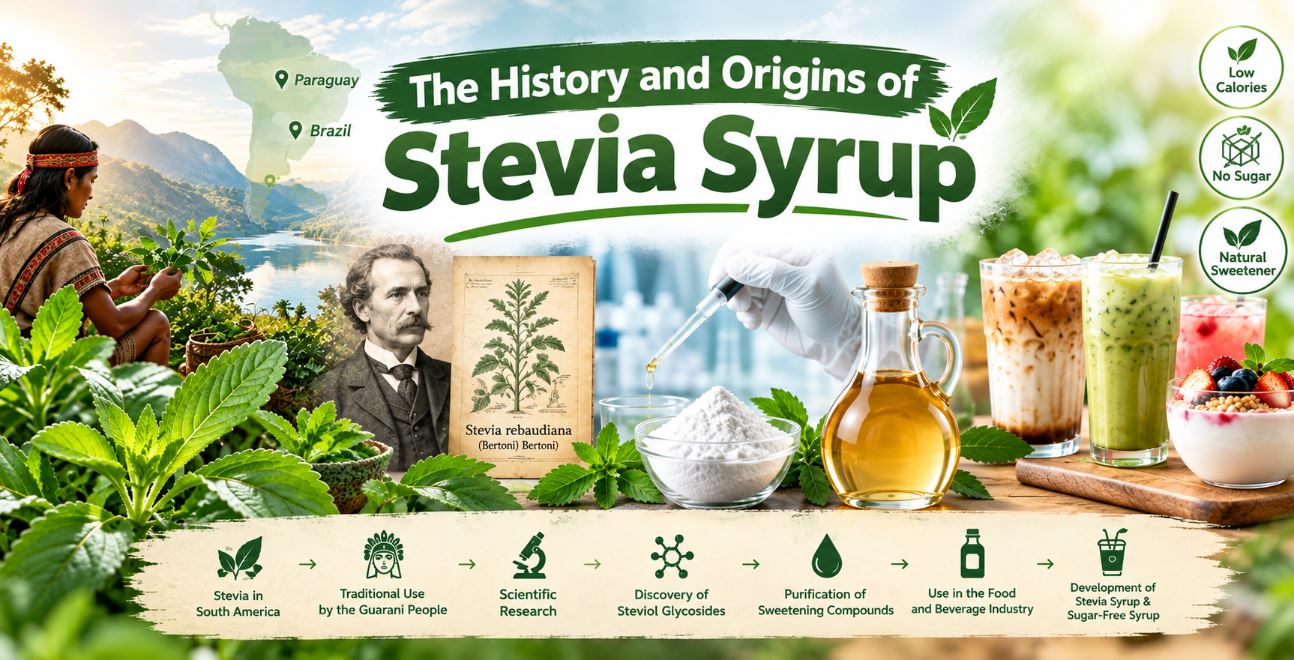
Stevia Syrup / Sugar-Free Syrup is a product developed from the idea of using plant-based sweetness as an alternative to sugar. Its origins can be traced back to stevia (Stevia rebaudiana), a plant native to South America, particularly Paraguay and Brazil.
The Origins of Stevia
Stevia has a history of use dating back hundreds of years. The Guarani people, an Indigenous group in South America, traditionally used stevia leaves to add sweetness to food and beverages. They also used the leaves to prepare sweet herbal drinks and tea.
In 1887, South American naturalist Antonio Bertoni documented stevia and contributed to its scientific study. The plant later became known by its scientific name, Stevia rebaudiana (Bertoni) Bertoni.
From Stevia Leaves to Sweetening Compounds
The sweetness of stevia does not come from sucrose, the main type of sugar found in table sugar. Instead, it comes primarily from a group of compounds known as steviol glycosides, which naturally occur in stevia leaves.
Important steviol glycosides include stevioside, rebaudioside A (Reb A), rebaudioside D, and rebaudioside M.
These compounds can provide intense sweetness in very small quantities compared with table sugar. This characteristic led scientists and food manufacturers to develop methods for extracting and purifying the sweet compounds from stevia leaves.
As a result, modern stevia sweeteners are different from simply using whole stevia leaves or ground dried leaves.
The Growing Popularity of Stevia in Asia
Japan played an important role in the development and commercial use of stevia as a sweetener. Stevia extracts have been used in Japan for several decades and later became increasingly popular in countries such as China, South Korea, Brazil, and other markets around the world.
As consumers became increasingly interested in reducing their sugar intake, stevia gained attention as a plant-based sweetening ingredient for foods and beverages.
How Did Stevia Syrup Develop?
As stevia extracts became more widely used in the food industry, manufacturers developed them into different forms, including powders, liquid solutions, and concentrated sweetening products.
This development eventually led to products commonly marketed as stevia syrup or sugar-free syrup.
Stevia syrup is generally a concentrated liquid sweetener designed to add sweetness to beverages and foods. It can be used in coffee, tea, milk tea, cocoa, smoothies, desserts, and many other recipes.
However, stevia syrup does not necessarily consist entirely of stevia extract. Different brands may use different formulations, which can include other sweeteners, water, flavorings, thickening agents, or other ingredients designed to create a particular taste, texture, and consistency.
Therefore, consumers should always check the ingredient list and nutrition information on the product label.
Stevia Syrup in the Modern Era
Today, stevia-derived sweeteners are used in a wide range of foods and beverages. Regulatory authorities in different countries have evaluated various highly purified steviol glycosides for use as food sweeteners.
One important distinction is that highly purified steviol glycosides should not automatically be considered the same as crude stevia extracts or whole stevia leaves. Their regulatory status and permitted uses can differ depending on the country and the specific type of stevia ingredient.
The development of stevia-based sweeteners reflects the combination of traditional knowledge about plants with modern food science and extraction technology.
From a Traditional Plant to a Modern Product
The history of stevia syrup can be summarized as follows:
Stevia in South America → Traditional use by the Guarani people → Scientific research → Discovery and development of steviol glycosides → Purification of sweetening compounds → Use in the food and beverage industry → Development of stevia syrup and sugar-free syrup products
In this way, stevia syrup represents the evolution of a traditional plant-based source of sweetness into a modern food ingredient.
Today, stevia syrup has become part of the growing sugar-free and reduced-sugar food and beverage market, offering manufacturers and consumers another option for creating sweet-tasting products while reducing or replacing conventional sugar.
